
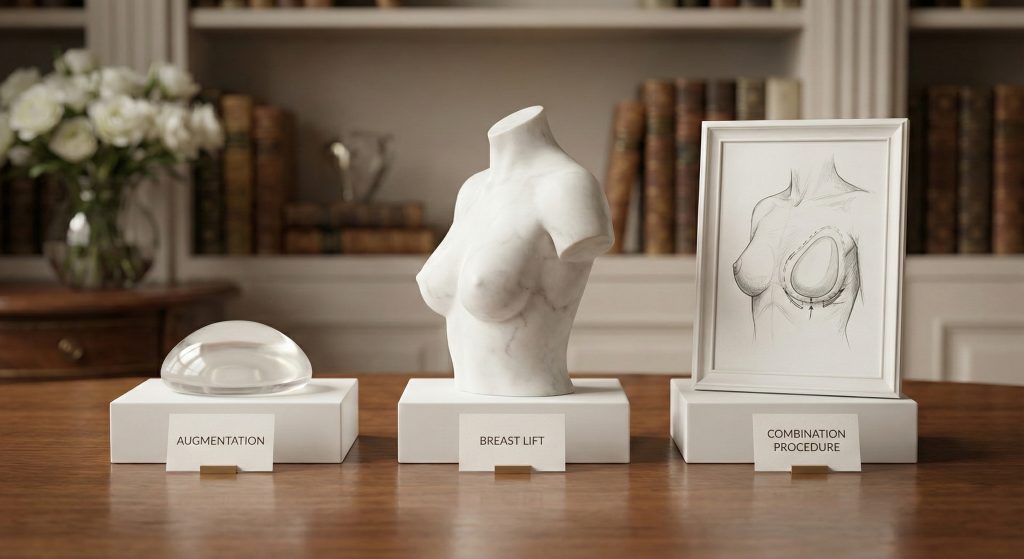
Navigate the choice between breast lift, augmentation, or combination procedures with expert guidance
Two patients walked into my Beverly Hills office last Tuesday with nearly identical complaints: “I’m unhappy with how my breasts look.” But their solutions couldn’t have been more different. Jennifer, 34, needed volume that only breast augmentation could provide. Susan, 42, had plenty of volume but needed repositioning through a breast lift. Both left satisfied, but with completely different procedures.
This scenario plays out in my consultation room almost daily. Many women assume that any breast concern requires implants, while others believe they need surgery when non-surgical options might suffice. After two decades of helping women achieve their ideal breast appearance, I’ve learned that the right choice depends on understanding what you’re actually trying to accomplish.
The decision between breast lift, augmentation, or a combination procedure isn’t just about size – it’s about shape, position, proportions, and how your breasts fit your lifestyle and self-image. Making the wrong choice leads to disappointment and sometimes additional surgery. Making the right choice transforms not just your appearance, but often your confidence and quality of life.
Key Point: Beautiful breast enhancement isn’t about choosing implants or lifting – it’s about understanding what changes will achieve your specific goals and complement your natural body proportions.
Understanding Your Breast Enhancement Goals
Before we discuss procedures, let’s identify what you’re actually trying to achieve. I start every consultation with the same question: “When you look in the mirror, what specifically bothers you?”
The answer guides us toward the right solution:
- Volume concerns: “My breasts are too small” or “I’ve lost fullness after pregnancy”
- Position concerns: “My breasts sag” or “My nipples point downward”
- Shape concerns: “My breasts have no upper fullness” or “They’re different sizes”
- Proportion concerns: “They don’t match my body frame” or “They look deflated”
Understanding your primary concern determines whether you need added volume (augmentation), repositioning (lift), or both.
Breast Augmentation: When Volume is the Answer
Breast augmentation addresses one primary issue: lack of breast volume. If your breasts are well-positioned but simply too small for your preferences, augmentation alone may be perfect.
Ideal Candidates for Augmentation Alone
You’re likely a good candidate for breast augmentation without lifting if you:
- Have good breast shape and nipple position
- Want increased size but are happy with current shape
- Have minimal sagging or drooping
- Have adequate skin elasticity
- Haven’t experienced significant volume loss from pregnancy or weight changes
I remember Lisa, a 28-year-old fitness instructor who came to me frustrated that her athletic build left her with very little breast tissue. “I love my body, I just want to fill out my clothes better,” she told me. A straightforward breast augmentation gave her the volume she wanted while maintaining the athletic proportions she worked hard to achieve.
The Volume-Only Approach
When augmentation alone is appropriate, the focus is on:
- Size selection: Choosing implants that complement your frame
- Shape choice: Round vs. shaped implants for desired projection
- Placement decision: Above or below the muscle for optimal results
- Incision location: Minimizing visible scarring
The advantage of augmentation alone is typically shorter surgery time, faster recovery, and predictable results when you have good existing breast shape.
Breast Lift: When Position and Shape are Key
Breast lifting (mastopexy) addresses sagging, drooping, and poor breast shape without necessarily adding volume. Many women are surprised to learn how much improvement can be achieved through repositioning alone.
Understanding Breast Sagging (Ptosis)
Breast sagging occurs due to several factors:
- Aging: Natural loss of skin elasticity and collagen
- Pregnancy and breastfeeding: Tissue expansion and contraction
- Weight fluctuations: Stretching and deflation of breast tissue
- Gravity: Continuous downward pull over time
- Genetics: Natural breast tissue characteristics
We classify breast sagging into degrees:
- Grade 1 (Mild): Nipple at or slightly below the breast crease
- Grade 2 (Moderate): Nipple 1-3 cm below the breast crease
- Grade 3 (Severe): Nipple more than 3 cm below the crease, pointing downward
When Breast Lift is the Right Choice
You’re likely a good candidate for breast lift if you:
- Are satisfied with your breast size but not their position
- Have nipples that point downward or sit below the breast crease
- Have lost breast shape after pregnancy or weight loss
- Feel your breasts lack upper fullness or projection
- Have stretched areolas that you’d like reduced
Sarah, a 39-year-old mother of two, came to me saying, “I actually think my breasts are too big now, but they just hang there with no shape.” A breast lift without implants restored her youthful breast contours and gave her back the confidence to wear fitted clothing.
Breast Lift Techniques: Choosing the Right Approach
Not all breast lifts are the same. The technique I choose depends on your degree of sagging, desired outcome, and willingness to accept various scar patterns.
Anchor Lift (Inverted-T Mastopexy)
The anchor lift is the most comprehensive breast lifting technique and my go-to approach for significant sagging or major reshaping needs.
The technique involves:
- Incision around the areola
- Vertical incision from areola to breast crease
- Horizontal incision along the breast crease
- Maximum tissue repositioning and reshaping capability
Best for patients who have:
- Grade 2-3 breast sagging
- Significantly stretched or enlarged areolas
- Need for major breast reshaping
- Excess skin that requires maximum removal
- Asymmetry correction needs
Advantages:
- Most dramatic improvement in shape and position
- Best long-term results for severely sagging breasts
- Can address multiple issues simultaneously
- Most reliable technique for achieving ideal breast contour
Considerations:
- More extensive scarring (though scars typically fade well)
- Longer recovery than less invasive techniques
- May affect future breastfeeding capability
Lollipop Lift (Vertical Mastopexy)
The lollipop lift offers significant improvement with less extensive scarring, making it popular among patients seeking substantial results without the anchor scar pattern.
The technique involves:
- Incision around the areola
- Vertical incision from areola to breast crease
- No horizontal scar along the breast crease
- Excellent reshaping with reduced scarring
Best for patients who have:
- Grade 1-2 breast sagging
- Good skin quality and elasticity
- Desire for significant improvement with minimal scarring
- Moderate reshaping needs
Advantages:
- Reduced scarring compared to anchor lift
- Excellent breast shape improvement
- Faster recovery than anchor technique
- Natural-looking results
Considerations:
- May not provide enough lift for severe sagging
- Requires good skin elasticity for optimal results
- Potential for minor shape irregularities at breast crease
Choosing Between Anchor and Lollipop
The decision between these techniques isn’t just about scar preferences – it’s about achieving the best possible results for your specific anatomy.
I remember Karen, who insisted she only wanted a lollipop lift because of the scarring concerns. After examining her breasts and discussing her goals, I explained that her degree of sagging would likely lead to poor results with the vertical-only technique. She chose the anchor lift and later told me, “Dr. Neavin, I’m so glad you talked me into the anchor lift. The scars faded beautifully, and I could never have achieved this shape with the other technique.”
I typically recommend anchor lift when:
- The nipple is more than 2-3 cm below the breast crease
- There’s significant excess skin requiring removal
- The patient wants maximum reshaping and projection
- Long-term shape stability is the priority
I typically recommend lollipop lift when:
- The sagging is mild to moderate
- Skin quality is good with reasonable elasticity
- The patient strongly prefers reduced scarring
- The goals are achievable without extensive skin removal
When is a Breast Lift Medically Necessary?
While most breast lifts are cosmetic procedures, some situations involve medical necessity that may qualify for insurance coverage.
Medical Indications for Breast Lift
Symptomatic breast ptosis may cause:
- Chronic back, neck, and shoulder pain
- Skin irritation and rashes under the breasts
- Poor posture due to breast weight and position
- Difficulty with exercise and physical activities
- Psychological distress affecting quality of life
Documentation typically required includes:
- Physician documentation of symptoms
- Conservative treatment attempts (physical therapy, proper bras)
- Photographic documentation of physical findings
- Impact on daily activities and quality of life
I had a patient, Maria, whose severely sagging breasts caused chronic shoulder grooving from bra straps and daily back pain. After documenting her symptoms and failed conservative treatments, her insurance covered the lift procedure as medically necessary reconstruction.
Insurance Considerations
Insurance coverage for breast lift varies by provider and specific circumstances:
- May be covered: Procedures addressing documented physical symptoms
- Usually not covered: Purely cosmetic enhancement procedures
- Combination procedures: Lift may be covered while implants remain out-of-pocket
Even when medically indicated, insurance approval isn’t guaranteed. I work with patients to provide proper documentation and support their coverage requests when appropriate.
Combination Procedures: Getting the Best of Both Worlds
Many patients benefit from combining breast lift with augmentation – addressing both volume and position concerns simultaneously. This “augmentation mastopexy” can achieve results that neither procedure could accomplish alone.
When to Consider Combination Surgery
You might be a candidate for combined lift and augmentation if you:
- Have lost both volume and shape (common after pregnancy)
- Want larger breasts but also need repositioning
- Have adequate volume but poor distribution
- Desire the most comprehensive breast enhancement
I remember Jessica, who came to me after nursing two children. “I lost all my volume up top, but there’s still tissue hanging down below,” she explained. A combination lift and augmentation redistributed her existing tissue while adding volume where she needed it most.
Advantages of Combination Surgery
- Addresses multiple concerns in one procedure
- Single recovery period
- Optimal breast proportions and positioning
- Often more cost-effective than staged procedures
- Comprehensive aesthetic improvement
Considerations for Combination Surgery
- More complex surgery with longer operative time
- Higher risk of minor complications
- May require revision more often than single procedures
- Extended recovery compared to either procedure alone
- Higher upfront cost
Making the Right Decision: A Systematic Approach
With so many options available, how do you choose the right approach? I’ve developed a systematic decision-making process that helps guide patients toward their optimal solution.
Step 1: Assess Your Primary Concern
Volume Assessment:
- Are you satisfied with your breast size?
- Have you lost volume due to pregnancy, weight loss, or aging?
- Do you want to be larger than your natural maximum size?
Position Assessment:
- Do your nipples point straight ahead or downward?
- Is the nipple at or below the breast crease?
- Do you have upper breast fullness or a deflated appearance?
Shape Assessment:
- Are you happy with your breast shape and projection?
- Do your breasts have a youthful contour?
- Is there significant asymmetry between sides?
Step 2: Consider Your Lifestyle and Goals
- Activity level: Impact on exercise and daily activities
- Clothing preferences: Fitted tops, swimwear, professional attire
- Future pregnancy plans: Timing considerations for optimal results
- Maintenance preferences: Desire for long-term vs. short-term solutions
Step 3: Evaluate Surgical Considerations
- Recovery time available: Work and family obligations
- Scar acceptance: Comfort level with different scar patterns
- Risk tolerance: Comfort with surgical complexity
- Budget considerations: Investment in desired outcomes
The Consultation Process: What to Expect
A thorough consultation is essential for making the right decision. Here’s what happens during my comprehensive breast consultation process:
Medical History and Goals Discussion
- Previous pregnancies and breastfeeding history
- Weight fluctuations and current stability
- Family history of breast cancer
- Current medications and medical conditions
- Specific aesthetic goals and concerns
Physical Examination
- Breast size, shape, and symmetry assessment
- Nipple position and areola size evaluation
- Skin quality and elasticity testing
- Chest wall measurements and proportions
- Overall body frame and proportions
Treatment Planning
- Discussion of appropriate procedure options
- Explanation of techniques and expected outcomes
- Review of risks, benefits, and alternatives
- Realistic timeline for results and recovery
- Cost breakdown and financing options
Visualization and Decision Support
I use several tools to help patients visualize potential outcomes:
- Before-and-after galleries: Patients with similar anatomy and goals
- Sizing exercises: Trying on different implant sizes when appropriate
- Computer imaging: Digital simulation of potential results
- Detailed drawings: Explaining surgical approaches and scar placement
Recovery Expectations: What Each Procedure Involves
Understanding recovery helps patients plan appropriately and set realistic expectations for each procedure type.
Breast Augmentation Recovery
First week:
- Moderate discomfort managed with medication
- Limited arm movement and no lifting over 10 pounds
- Surgical bra worn continuously
- Most patients return to desk work within 3-5 days
Weeks 2-4:
- Gradual increase in activity levels
- Light exercise permitted (walking, gentle stretching)
- Driving when comfortable and off pain medication
- Implants begin settling into final position
6-12 weeks:
- Return to full exercise and normal activities
- Final shape and position apparent
- Scars begin to fade and soften
Breast Lift Recovery
First week:
- More discomfort than augmentation alone due to tissue manipulation
- Surgical bra and possible drains for 24-48 hours
- Limited arm movement and no lifting
- Return to work typically by day 7-10
Weeks 2-6:
- Gradual activity increase with scar protection
- Scar care routine begins
- Shape continues to improve as swelling resolves
- Light exercise permitted around week 4
3-6 months:
- Scars mature and continue to fade
- Final breast shape and position established
- Full activity clearance including heavy lifting
Combination Procedure Recovery
- Typically follows breast lift timeline
- May have slightly extended restrictions
- More swelling and longer shape evolution
- Higher probability of minor revisions
Long-Term Results and Maintenance
Understanding what to expect long-term helps patients make informed decisions and maintain their results.
Breast Augmentation Longevity
- Implant durability: Modern implants often last 15-20+ years
- Shape maintenance: Generally stable with proper size selection
- Future considerations: Possible replacement due to personal preference changes
- Aging effects: Natural breast tissue continues to age around implants
Breast Lift Longevity
- Shape maintenance: 10-15 years of significant improvement typical
- Aging considerations: Natural aging continues but from improved baseline
- Lifestyle factors: Weight stability and gravity protection help maintain results
- Touch-up possibilities: Minor revisions sometimes beneficial over time
Maximizing Your Results Long-Term
- Maintain stable weight within 10-15 pounds of surgery weight
- Wear supportive, well-fitting bras
- Protect scars from sun exposure during healing
- Follow all post-operative instructions carefully
- Attend regular follow-up appointments
- Address any concerns promptly with your surgeon
Cost Considerations and Value Analysis
Understanding the investment helps patients budget appropriately and choose procedures that provide the best long-term value.
Typical Cost Ranges (Beverly Hills pricing)
- Breast augmentation alone: $8,000-12,000
- Breast lift alone: $9,000-13,000
- Combination lift and augmentation: $12,000-18,000
- Revision procedures: $8,000-15,000 depending on complexity
Factors Affecting Cost
- Procedure complexity: More extensive procedures cost more
- Surgeon experience: Board certification and expertise command premium pricing
- Facility type: Accredited surgical centers vs. office-based procedures
- Geographic location: Beverly Hills pricing reflects local market rates
- Implant selection: Premium implants add to material costs
Value Considerations
- Longevity of results: Cost per year of satisfaction
- Revision rates: Higher upfront investment may reduce revision needs
- Quality of life impact: Difficult to quantify but often substantial
- Professional reputation: Experienced surgeons often provide better value
Choosing the Right Surgeon
The success of your breast procedure depends heavily on surgeon selection. This decision is as important as choosing the right procedure.
Essential Credentials
- Board certification: American Board of Plastic Surgery
- Hospital privileges: Active privileges at accredited hospitals
- Continuing education: Regular training in new techniques
- Malpractice history: Clean professional record
- Peer recognition: Respect within the plastic surgery community
Experience and Specialization
- Thousands of breast procedures performed
- Regular performance of the specific procedure you’re considering
- Experience with revision and complex cases
- Aesthetic philosophy that aligns with your goals
- Strong before-and-after portfolio
Communication and Comfort
- Clear explanation of options and recommendations
- Honest discussion of limitations and risks
- Willingness to answer questions thoroughly
- Comfortable, professional office environment
- Accessible for post-operative care and concerns
My Philosophy: Surgery with Symmetry
After two decades of breast surgery, I’ve developed what I call the “Surgery with Symmetry” philosophy. This approach guides every recommendation I make and every procedure I perform.
Core Principles
- Individual assessment: Every patient receives a customized treatment plan
- Natural proportions: Enhancement should complement, not overwhelm, your frame
- Long-term thinking: Decisions made with 10-20 year perspective
- Honest communication: Realistic expectations set from the beginning
- Quality over quantity: Excellence in technique over volume of procedures
This philosophy means sometimes recommending less extensive procedures than patients initially request, or suggesting they wait until their goals are clearer. My job is to help patients achieve their best possible results, not just perform the procedures they think they want.
Common Mistakes to Avoid
Learning from others’ experiences can help you make better decisions and avoid common pitfalls in breast enhancement.
Mistake #1: Choosing Based on Price Alone
Breast surgery is an investment in your long-term satisfaction and safety. Choosing the cheapest option often leads to poor results, complications, or the need for revision surgery that ultimately costs more.
Mistake #2: Ignoring the Need for Lifting
Many patients think bigger implants will solve sagging problems. In reality, implants can make sagging look worse by adding weight without addressing position. If you need lifting, implants alone won’t achieve your goals.
Mistake #3: Unrealistic Size Goals
Choosing implants that are too large for your frame leads to unnatural results, increased complication rates, and often the need for revision surgery. The goal should be proportionate enhancement, not maximum size.
Mistake #4: Poor Recovery Planning
Underestimating recovery needs leads to complications, delayed healing, and suboptimal results. Plan for adequate time off work and help with daily activities.
Mistake #5: Skipping the Consultation Process
Rushing into surgery without thorough consultation and careful consideration often leads to disappointment. Take time to understand your options and choose thoughtfully.
When Revision Surgery May Be Needed
While most breast procedures provide long-lasting satisfaction, some situations may warrant revision surgery over time.
Common Reasons for Revision
- Size changes: Desire for larger or smaller implants
- Aging effects: Natural changes affecting results over time
- Lifestyle changes: New activity levels or aesthetic preferences
- Complications: Capsular contracture or implant issues
- Asymmetry: Minor irregularities requiring correction
Minimizing Revision Risk
- Choose an experienced, board-certified surgeon
- Follow all post-operative instructions carefully
- Maintain stable weight and healthy lifestyle
- Address any concerns promptly
- Attend all scheduled follow-up appointments
When revision is needed, it’s usually straightforward and highly successful when performed by an experienced surgeon.
Final Decision-Making: Putting It All Together
After reviewing all the information, how do you make your final decision? Here’s my recommended decision-making process:
Step 1: Clarify Your Primary Goals
Write down exactly what you want to achieve. Be specific about size, shape, and proportions. This clarity will guide your decision-making.
Step 2: Assess Your Situation Honestly
Look objectively at your current breast anatomy. What changes are needed to achieve your goals? Do you need volume, repositioning, or both?
Step 3: Consider Your Constraints
What limitations do you have regarding recovery time, budget, or scar acceptance? Be realistic about what you can accommodate.
Step 4: Consult with Qualified Surgeons
Meet with at least 2-3 board-certified plastic surgeons. Compare their recommendations and see if there’s consensus about your best options.
Step 5: Take Time to Decide
Don’t rush this decision. Take at least a few weeks to consider your options and ensure you’re comfortable with your choice.
The Journey Ahead: What to Expect
Once you’ve made your decision, understanding the journey ahead helps set appropriate expectations and prepare for success.
Remember Jennifer and Susan from the beginning of this article? Six months after their procedures, both patients achieved exactly what they wanted – Jennifer with beautifully proportioned breast augmentation that enhanced her naturally good breast shape, and Susan with a breast lift that restored her youthful contours without changing her size. Different problems, different solutions, but both achieved their goals through careful decision-making and appropriate procedure selection.
Your breast enhancement journey will be unique to you, but the principles remain the same: understand your goals, choose the right procedure for your anatomy and lifestyle, select a qualified surgeon, and commit to proper recovery and care.
The decision between breast lift, augmentation, or combination procedures isn’t just about the immediate results – it’s about achieving long-term satisfaction that enhances your confidence and quality of life for years to come.
Ready to Explore Your Breast Enhancement Options?
Every patient’s anatomy and goals are unique. During your consultation, we’ll analyze your specific situation, discuss all appropriate options, and develop a personalized treatment plan that delivers natural, beautiful results aligned with your goals.
Medical Disclaimer: This content is for informational purposes only and does not constitute medical advice. Individual results may vary. All surgical procedures carry risks and benefits that should be discussed with a qualified healthcare provider. Consult with a board-certified plastic surgeon for personalized medical advice regarding breast enhancement options.