

Table of Contents
- “Ozempic Face” Explained: Why Rapid Weight Loss Hollows the Face
- Am I a Candidate for Dermal Fillers After GLP-1 Injections?
- The Best Dermal Fillers: What I Use & Why
- Fat Transfer as a Longer-Term Volume Solution
- Where We Place Filler for Ozempic Face Treatment: Area-by-Area Guide
- My Technique: Natural, Anatomically-Based Layering—Never “Overfilled”
- Safety First: Minimizing Risk
- Results, Longevity & Maintenance While You’re On (or Off) GLP-1s
- FAQs
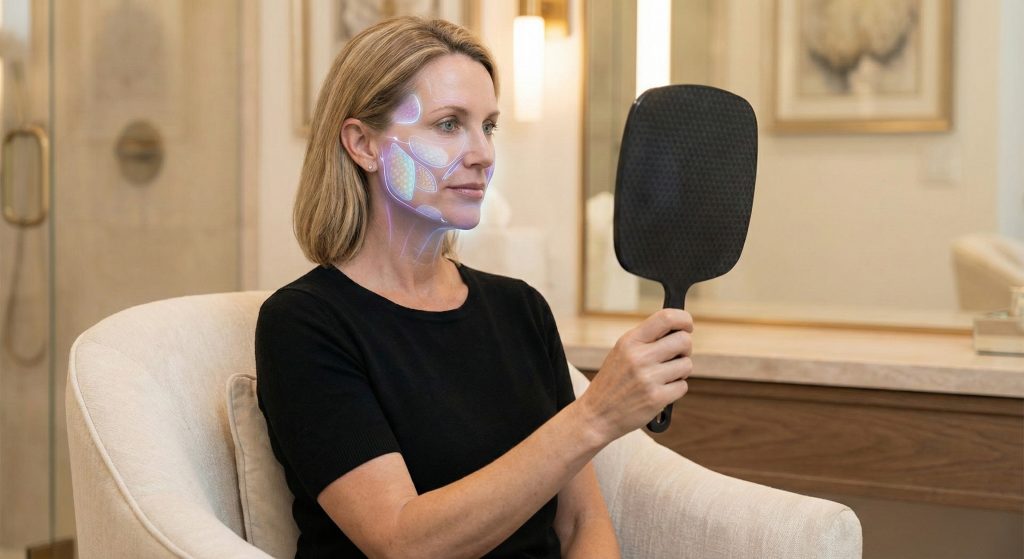
You’ve probably heard the term “Ozempic face” floating around social media. It’s not pretty—think sunken cheeks, sagging skin, hollow temples, and an overall gaunt appearance that makes people look older than their years. In some cases, it even enhances the appearance of your wrinkles. It has become one of the side effect concerns for individuals who are taking Ozempic, Wegovy, or similar semaglutide drugs. Luckily, there is a minimally-invasive and minimal downtime treatment using dermal fillers!
Key Takeaways
- Rapid weight loss—especially from GLP-1 medications like Ozempic—can cause “Ozempic face,” characterized by hollow cheeks, sunken temples, and sagging skin as fat pads diminish and skin elasticity is challenged.
- Not all patients need fillers right away: candidacy depends on the amount of weight lost, age, skin condition, and whether facial volume has stabilized.
- For targeted hollows (cheeks, tear-troughs, temples), hyaluronic acid (HA) fillers (such as Juvederm or Restylane) offer immediate results, reversible options, and precision control.
- For more diffuse or significant volume loss, biostimulatory fillers (such as Sculptra or Radiesse) stimulate collagen formation and structural lift, but require multiple sessions and patience.
- A strategic layering approach is best: rebuild deep structural support first (on bone), then refine surface contours; avoid “over-filling” for natural results.
- Timing matters: it’s preferable to wait until weight is stable (generally at least three months) before performing filler treatments in this context.
- Longevity and maintenance vary: HA fillers for Ozempic-related volume loss may last 9-18 months; collagen-stimulating options may last 18-24 months or more, depending on weight stability.
- Safety and realistic expectations are critical: Rapid weight loss alters facial anatomy and vascular mapping, so an experienced injector is essential for risk mitigation and achieving the best outcome.
“Ozempic Face” Explained: Why Rapid Weight Loss Hollows the Face
Here’s what’s really happening: When you lose weight rapidly, your body doesn’t just shed fat from your belly or thighs. It pulls fat from everywhere, including your face. Your cheeks, which rely on fat pads for that youthful fullness, start to deflate like a balloon losing air. This is how you end up with Ozempic face.
The problem gets worse with age. If you’re over 40, your skin has already lost some elasticity. When facial fat disappears quickly, your skin can’t bounce back the way it did in your twenties. Instead of shrinking to fit your new facial contours, it hangs loose, enhancing your wrinkles, creating that hollow, aged look.
Think of it like taking the stuffing out of a pillow—the fabric doesn’t magically get smaller. It just looks empty and wrinkled.
Ozempic and similar medications can trigger weight loss of 15-20% in just months. That’s great news for your overall health, but your face wasn’t designed to handle such dramatic changes so quickly. The result? You might hit your goal weight but end up looking like you’ve aged a decade. The good news? Treating Ozempic face is possible, and there are many different solutions. Whether you’re looking at surgery solutions like a facelift, transferring fat, chin augmentation, or the minimally invasive route like dermal fillers, we have options to reverse the effects of Ozempic face.
Am I a Candidate for Dermal Fillers After GLP-1 Injections?
Not everyone who loses weight on Ozempic or similar medications needs dermal fillers. It depends on how much weight you’ve lost, your age, and where you’re seeing volume loss, and if rejuvenation using fillers is necessary.
You might be a good candidate for dermal fillers if you’ve lost 15% or more of your body weight, taking Ozempic, and notice hollowing in key areas of your face appearance—your cheeks, temples, or under-eye region. If you’re over 40, you’re more likely to see these changes since your skin doesn’t snap back as easily, and the loss of facial volume affects your appearance far more drastically than a younger individual. This is where fillers can make a drastic change.
But here’s the catch: timing matters. Don’t rush into dermal fillers while you’re still losing weight or if you’re still on Ozempic. Your face will keep changing, you will continue to use facial volume, and you’ll end up needing adjustment fillers every few months. Wait until your weight stabilizes for at least three months. That way, you don’t have to continue with fillers every few months. You can create a coherent plan so that your face isn’t constantly changing using fillers.
On the contrary, some people aren’t ideal candidates for dermal fillers. If you have very thin skin or a history of filler complications, you might want to explore other options first before exploring dermal fillers. The same goes if you’re planning losing more weight—those dermal fillers won’t look right if your face keeps shrinking. Skin elasticity also plays a huge role on what type of results you will end up getting.
The best approach? Schedule a consultation with an experienced injector who understands how to use facial fillers specifically and also understands facial anatomy. That way, they can create a realistic plan for your facial features. Additionally, consider dermal fillers only if you are no longer using Ozempic for weight loss.
The Best Dermal Fillers: What I Use & Why
When it comes to filler treatments for Ozempic Face, there are different fillers and treatment options we can use to achieve the most desirable result. The best part? Minimal downtime! It is not like other plastic surgery procedures, which require weeks of recovery. Dermal fillers are quick and offer great results.
I prefer Juvederm, Voluma, and Restylane for structure & lift (Cheeks, Temples, Tear Trough). If you have lost a significant amount of weight and you need targeted facial volume replacement, hyaluronic acid fillers are my go-to choice. Products like Juvederm and Restylane work immediately and give me precise control over where volume goes.
I use these facial fillers for specific problem areas—sunken cheeks, wrinkles, hollow temples, and deep tear troughs. The beauty of HA fillers? They’re reversible. If something doesn’t look right, I can dissolve them with hyaluronidase. That safety net is crucial when you’re rebuilding facial architecture to improve the overall facial appearance. HA fillers are the go-to to restore facial volume.
For cheeks, I focus on restoring the apple and mid-face projection you’ve lost. In temples, we use fillers to fill those sunken areas that make you look gaunt. Tear troughs require the most finesse—too much filler here creates that puffy, unnatural look we all want to avoid.
Results last 12-18 months, depending on the dermal fillers used and your metabolism. I typically start conservatively—you can always add more, but taking away is trickier. The positive note is that these fillers offer the most customizable filler results due to the ability to dissolve the injections.
Sculptra and Radiesse for Facial Volume
For patients with significant weight loss after taking Ozempic, I turn to biostimulatory fillers like Sculptra and Radiesse. These fillers don’t just fill—they actually stimulate your body to rebuild collagen over time. Collagen is the skin’s support beams. More collagen production = tighter-looking cheeks, a cleaner jawline, and less sag. Skin rich in collagen is more resistant to wrinkles, creases less, and holds expression lines at bay.
Sculptra fillers is my favorite for global facial restoration. We inject these fillers in a series of sessions, usually three treatments spaced six weeks apart. You won’t see instant gratification, but the gradual improvement looks incredibly natural. Your friends will notice you look refreshed, not “done.”
Radiesse works faster, giving immediate results plus long-term collagen stimulation.I often use these fillers for deeper nasolabial folds and marionette lines that develop after significant weight loss.
The downside? These treatments require patience and can’t be reversed like HA fillers. But the results can last two years or more, making them cost-effective for long-lasting volume restoration.
Fat Transfer as a Longer-Term Volume Solution
Fat transfer involves harvesting your own fat through liposuction and injecting it into your face. It’s the most natural option since you’re using your own tissue.
The results can be permanent, but there’s a catch—not all transferred fat survives. You might need multiple sessions, and results can be unpredictable. I reserve this for patients who want the most natural, long-lasting solution and don’t mind a longer recovery period.
Where We Place Filler for Ozempic Face Treatment: Area-by-Area Guide
As the face thins out, deep hollows become more noticeable, especially in the midface and temples. This is why fillers are often the first step in restoring natural facial volume
Cheeks: Restoring the Apple
I focus on injected fillers in the mid-cheek area where you’ve lost that youthful “apple” shape. Most people don’t realize how much this area affects your entire face—when it’s hollow, everything else looks droopy. I’ll place filler deep on the cheekbone to create lift, then add lighter touches closer to the surface for natural fullness.
Temples: Filling the Sunken Look
Hollow temples scream “rapid weight loss” more than almost anything else. I use a cannula here to distribute filler smoothly across the temporal area. It’s not just about volume—restoring temple fullness lifts the outer corners of your eyes and softens harsh facial angles.
Tear Troughs: The Delicate Zone
This area requires the lightest touch. Too much filler creates bags; too little does nothing. I place tiny amounts of a soft HA filler just above the orbital rim, never directly under the eye. The goal isn’t to eliminate every shadow—it’s to soften the harsh transition between your lower lid and cheek.
Nasolabial Folds: Beyond Just Lines
After significant fat loss, these aren’t just wrinkles—they’re deep grooves. I don’t just fill the fold itself. Instead, I restore cheek fullness first, which naturally softens these lines from above.
Jawline: Defining What’s Left
Strategic jawline filler can restore definition that weight loss took away, creating better facial proportions overall.
My Technique: Natural, Anatomically-Based Layering—Never “Overfilled”
Fillers allow me to reshape the face with precision, adding support exactly where the facial fat pads have collapsed. When used properly, fillers recreate youthful contours without changing the character of the face. I don’t believe in the “Instagram face” approach. When you’ve lost significant weight due to Ozempic, your face needs rebuilding, not inflating. That’s why I use what I call anatomical layering—replacing volume where it naturally belongs, not where it looks dramatic. This is where strategically
Deep Foundation First
I start with the deepest layer, placing filler directly on bone to recreate the structural support you’ve lost. Think of it like rebuilding a house—you need a solid foundation before you worry about the paint job. This deep placement lifts everything above it naturally.
Surface Refinement Last
Only after establishing that deep support do I add superficial touches. These final adjustments smooth transitions and restore natural contours. Most patients need far less surface filler than they expect because the deep work does most of the heavy lifting.
The “Less is More” Philosophy
I’d rather have you come back in two weeks for another dermal fillers session, asking for a touch-up, than leave my office looking puffy. Overcorrection is the fastest way to look artificial, especially when your face is already adjusting to weight loss.
Respecting Your Facial DNA
Your goal isn’t to look like someone else—it’s to look like the best version of yourself at your new weight. I study old photos to understand your natural facial proportions, then work to restore those relationships rather than chasing trends.
Safety First: Minimizing Risk
Your face has been through enough changes—the last thing you need is a filler complication. That’s why I’m extra cautious when treating patients with dermal fillers who’ve lost significant weight.
- Mapping Your Vascular Anatomy: Rapid weight loss can actually change where blood vessels sit in your face. I always use ultrasound guidance in high-risk areas like tear troughs and temples. It’s not overkill—it’s smart medicine. One blocked artery can cause permanent damage.
- Starting Slow, Building Smart: I never try to fix everything in one session. Your tissues need time to settle, especially after dramatic weight changes. I typically space treatments 4-6 weeks apart, giving your skin time to adapt.
- Choosing the Right Products: Not all fillers play well with compromised skin. I stick to proven hyaluronic acid products that I can reverse if needed. No permanent fillers, no experimental treatments—just reliable products with long safety records.
- Monitoring for Complications: I teach every patient the warning signs of vascular compromise: severe pain, skin color changes, or vision problems. These are rare but serious. When you know what to watch for, we can act fast if anything goes wrong.
Results, Longevity & Maintenance While You’re On (or Off) GLP-1s
If you’re Still Taking GLP-1s, your filler will last longer than usual— results last sometimes 18-24 months instead of the typical 12-15. Why? You’re not gaining weight back, so your face isn’t stretching the filler. But here’s the catch: if you’re still losing weight, we’ll need additional treatment to touch-up your dermal fillers as your face continues changing.
If you’re coming off your medication, this is where things get tricky. About 60% of people regain some weight within two years of stopping GLP-1s. If you gain back 10-15 pounds, your face will fill out naturally, and your fillers might look too full. I always warn patients about this possibility upfront. It’s all about maintaining a natural appearance, and maintaining your weight is one way you can insure that you wont need to remove or add any fillers.
I recommend annual check-ins, not automatic touch-ups. Your face at month six might look completely different than at month twelve. Some areas hold filler longer than others—cheeks typically last longer than lips or tear troughs. We discuss what happens if you stop the medication from day one. It’s not just about looking good now—it’s about having a plan that works long-term.
The key is not to chase lines, but to understand how the entire face has changed. With the right combination of fillers, we can lift, contour, and rebalance the face subtly and effectively.
FAQs
Can I get fillers while I’m still on semaglutide/tirzepatide? Yes, but I prefer waiting until your weight stabilizes for at least three months. Otherwise, we’re chasing a moving target when it comes to treating Ozempic face.
How many syringes do most patients need at first? Typically 3-6 syringes for the initial dermal fillers treatment to restore volume, depending on how much fillers you will need. We build gradually over multiple sessions.
Will I look puffy or “done”? Not with my technique. I focus on structural support, not surface inflation. Natural enhancement is always the goal.
What if I plan to switch off Ozempic—will my results change? Possibly. If you regain weight, your fillers might look too full. We discuss this scenario during your consultation.
Fillers vs. fat grafting: how do we decide? It depends on how much volume you need and your timeline. Fillers are predictable and reversible; facial fat grafting is permanent, more invasive plastic surgery, but also a viable option. Most patients choose fillers because they offer immediate improvement in areas of the face that have lost significant volume.
How much does do dermal fillers cost, and do you offer financing? The cost for treatment for Ozempic face varies depending on which dermal fillers are used. Treatment ranges $3,000-$8,000, depending on the areas treated. Yes, dermal fillers treatment can be financed and we offer CareCredit and payment plans to make treatment accessible.
How long do results last with Ozempic-related volume loss? HA fillers typically last 9–18 months depending on area and product. Sculptra and diluted Radiesse improve gradually and can hold 18–24 months with proper maintenance.
What areas usually make the biggest difference for Ozempic face? Temples and midface first. Then tear trough/lid-cheek junction, pre-jowl sulcus, chin, and jawline. Lifting the midface often softens nasolabial folds without filling lines directly.
Can dermal fillers help skin quality, not just volume? Yes. Sculptra and hyper-dilute Radiesse can improve tone and firmness. We can also add microneedling RF or laser for texture and pores.
What is the best dermal filler to use for Ozempic face? he most effective approach often combines hyaluronic acid fillers—to restore immediate volume in areas like the cheeks, temples, and under-eyes—with biostimulatory fillers such as Sculptra, which rebuild collagen for longer-lasting structure and lift. Treatment is customized based on your unique pattern of volume loss and skin laxity, creating natural, refreshed contours without looking overfilled.
Can Ozempic face go away on its own without using any dermal fillers? In some cases, yes. When weight stabilizes, the skin can tighten slightly and the hollow areas may improve on their own. But when the weight loss is more dramatic, the facial fat pads often don’t return, and the skin may not fully rebound. In those situations, the changes tend to persist without treatment. That’s why many patients choose subtle volume restoration or collagen-stimulating options to bring back a more balanced, rested appearance.
Schedule Consultation
If you’re suffering from Ozempic face or sagging skin, we are here to help you regain your appearance, your confidence, and more. Schedule a consultation at one of our offices, and our team will discuss how fillers may (or may not be) a treatment option for you.