

I get this question almost every week: “Dr. Neavin, should I get a lip lift or a lip flip?” And honestly? It depends entirely on what’s actually going on with your face.
Here’s the thing—these two procedures sound similar, but they solve completely different problems. One is surgery. One involves a few Botox injections. One is permanent. One lasts a few months. Choosing the wrong one won’t just waste your money, it’ll leave you frustrated with results that don’t match your expectations.
Let me break this down the way I explain it to patients.
What’s Actually Happening to Your Lips?
Before we talk about procedures, we need to talk about anatomy. Your lips age in two very different ways, and understanding this distinction is everything.
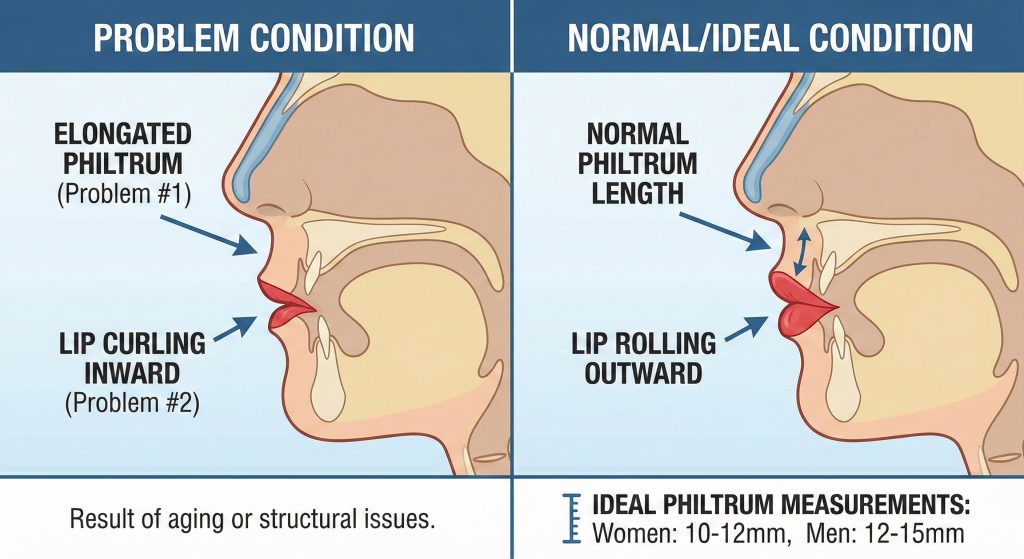
Problem #1: The elongated upper lip. As you age, the distance between your nose and your upper lip gets longer. Gravity, loss of bone density, and soft tissue descent all play a role. The result? Your upper teeth disappear. When your mouth is slightly open, you used to show a hint of teeth—that’s youth. Now you show nothing. No amount of filler fixes this. Trust me, I’ve seen patients try.
Problem #2: The lip that curls inward. Some people—and this can happen at any age—have upper lips that roll slightly inward when they smile. Instead of a full, pouty upper lip, you get what looks like a thin line. The lip itself isn’t small; it’s just hiding.
These are two different anatomical situations. And they require two different solutions.
The Lip Lift: A Permanent Structural Solution
A lip lift is surgery—minor surgery, but surgery nonetheless. I remove a small strip of skin from just beneath your nose (in the crease where no one will notice the scar), and this shortens the distance between your nose and lip.
The result? Your upper lip rolls outward and upward. You see more of the pink part of your lip. Your teeth show again when your mouth is relaxed. And you get back that youthful “ski slope” profile that fillers simply cannot create.
Who’s a good candidate for a lip lift?
- Your philtrum (the space between nose and lip) measures more than 13-15mm
- You’ve lost your tooth show over the years
- Fillers have stopped giving you satisfactory results
- You want permanent improvement, not maintenance treatments
What to expect: The procedure takes about an hour under local anesthesia. You’re awake—which means you can actually hold a mirror and approve the result before I make it permanent. Stitches come out in about a week, and most patients return to normal activities within a few days. The scar? In fair-skinned patients, it typically fades to nearly invisible within a year.
The Lip Flip: A Temporary Muscle Relaxer
A lip flip is completely different. No cutting. No stitches. No scarring.
I inject a small amount of Botox (or Dysport) into the orbicularis oris muscle—the circular muscle around your mouth. This relaxes the muscle just enough to let your upper lip curl slightly outward instead of rolling inward when you smile.
The result? More of your upper lip becomes visible. Your smile looks fuller. And if you’ve been frustrated by a gummy smile, a lip flip can actually reduce how much gum shows when you grin.
Who’s a good candidate for a lip flip?
- Your upper lip curls inward when you smile
- You want a subtle enhancement, not a dramatic change
- You prefer a non-surgical approach
- You’re looking for something quick with zero downtime
- You want to “test drive” a fuller lip look before committing to anything permanent
What to expect: The whole thing takes about five minutes. You’ll see results within a week, and they last about two to four months. Side effects are rare, though some patients notice temporary difficulty drinking through a straw or whistling. (Not a dealbreaker for most people.)
The Critical Difference: What Each Procedure Actually Does
Let me be direct here because this is where confusion happens.
A lip lift shortens the space between your nose and lip. It physically restructures your face. It’s permanent. It addresses the elongation that happens with age.
A lip flip does not shorten anything. It relaxes a muscle. It creates the illusion of a fuller lip by allowing more of your lip to show. It’s temporary. It addresses muscle behavior, not structural anatomy.
If your problem is an elongated philtrum, a lip flip won’t help you. If your problem is a lip that curls inward when you smile, a lip lift might be overkill.
What About Fillers?
Good question—because this is where many patients start. Fillers add volume. They can plump thin lips. They can define your Cupid’s bow. They’re great for what they do.
But here’s what fillers cannot do: they cannot shorten your philtrum, and they cannot permanently change where your lip sits on your face. If you’ve been chasing improvement with fillers for years and you’re still not satisfied, it might be time to ask whether volume is really your problem—or whether it’s structure.
I’ve had patients come to me after spending thousands on filler, frustrated that their lips still don’t look “right.” One look at their face tells me the issue isn’t volume. It’s the elongated space above their lip. No syringe can fix that.
Which Procedure is Right For You?
Take this quick assessment to understand which approach might address your specific concerns:
My Honest Take
Here’s what I tell patients: if you’re not sure, start with the lip flip. It’s temporary, it’s affordable, and it gives you a preview of what a fuller upper lip looks like on your face. If you love it, great—you can keep maintaining it. If you want something permanent, we can talk about your options.
But if you’re over 40 and you’ve noticed your teeth have disappeared when your mouth is relaxed, the lip flip probably isn’t going to address your actual concern. That’s a structural issue. And structure requires a structural solution.
The goal isn’t to convince you to have surgery. The goal is to match the right procedure to your actual anatomy. Anything else is just spinning your wheels.
Questions to Ask at Your Consultation
When you come in for a consultation—whether with me or any qualified provider—here’s what you should be asking:
- “What’s my philtrum measurement?” This is objective. A ruler doesn’t lie.
- “Is my concern volume-related or structure-related?” This determines which procedures are even on the table.
- “Can I see before-and-after photos of patients with similar anatomy?” This tells you whether your provider has experience with your specific situation.
- “What happens if I’m not happy with the result?” Lip flips are temporary—they wear off. Lip lifts are permanent—make sure you understand that going in.
The Bottom Line
Lip lift or lip flip? The answer isn’t about which procedure is “better.” It’s about which procedure matches your anatomy and your goals.
If your upper lip elongates with age and you’ve lost tooth show, a lip lift gives you permanent correction that no injectable can replicate.
If your lip curls inward when you smile and you want a subtle enhancement with zero downtime, a lip flip might be exactly what you need.
And if you’re still not sure? That’s what consultations are for. Let’s look at your face, measure your anatomy, and figure out together what’s actually going to move the needle for you.