

Benefits of Facial Implants
Permanent, Predictable Results
Unlike fillers that dissolve over time, facial implants provide permanent enhancement. Once placed, they become part of your facial structure—delivering consistent, predictable results that won't fade or require ongoing maintenance.
True Structural Change
Fillers add volume on top of bone; implants augment the bone itself. This allows for genuine architectural changes stronger cheekbones, a more defined jawline, improved chin projection that reshape your facial foundation.
Cost-Effective Over Time
A single cheek implant delivers more volume than dozens of filler syringes. When you factor in years of filler maintenance, facial implants often prove to be the smarter long-term investment for permanent enhancement.
Customizable & Reversible
Implants come in a wide variety of shapes and sizes, and can even be custom-made for your anatomy. If your goals change, implants can be removed or exchanged giving you flexibility that permanent fillers don't offer.
Expected Results
Facial implants deliver permanent structural enhancement that becomes part of your facial architecture. Results are visible immediately after swelling subsides and continue to refine as tissues settle. Unlike fillers that require ongoing maintenance, implants provide a one-time solution for lasting facial definition and balance.
Enhanced Facial Definition
Whether it's stronger cheekbones, a more projected chin, or a chiseled jawline, implants create the structural definition that forms the foundation of an attractive face. You'll notice improved contours from every angle.
Improved Facial Balance
A weak chin can make the nose appear larger; flat cheeks can make the face look long and gaunt. Implants restore proper proportions, bringing harmony to your features and creating a more aesthetically balanced appearance.
Masculine or Feminine Enhancement
The same implant can create different effects depending on placement. Dr. Neavin uses this knowledge to strengthen masculine features like a square jaw, or enhance feminine features like high cheekbones—tailored to your goals.
5-Star Experiences
I always felt like my chin was holding back my entire face. Dr. Neavin recommended a chin implant and the difference is incredible. My profile finally looks balanced, and people keep telling me I look more confident—they just can't pinpoint why. Exactly what I wanted.
"Dr. Neavin took the time to really analyze my face and explain what would work best for my goals. He was honest about what implants could and couldn't do. The results exceeded my expectations my jawline is stronger and my whole face looks more masculine and defined."
Types of Facial Implants
Facial implants are available for nearly every area of the face, each designed to address specific aesthetic goals. Implants are made from biocompatible materials—most commonly solid silicone or ePTFE (Gore-Tex)—and come in a wide variety of shapes and sizes. Dr. Neavin will recommend the implant type best suited to your anatomy and desired outcome.
01 Chin Implants
02 Cheek Implants (Malar & Submalar)
03 Jaw Implants (Mandible Implants)
04 Nasal & Pyriform Implants
Candidates
Ideal Candidates
Facial implants are ideal for men and women who want to permanently enhance their facial structure, improve proportions, or create a more balanced, attractive appearance.
You may be a good candidate if you:
- Have a weak or recessed chin that affects facial balance
- Want more prominent, defined cheekbones
- Desire a stronger, more chiseled jawline
- Have a “negative vector” face with midface retrusion
- Look gaunt or hollow due to lack of facial skeletal projection
- Are tired of repeated filler treatments and want a permanent solution
- Want to feminize or masculinize your facial features
- Are in good overall health with realistic expectations
Facial implants work for both younger patients seeking enhanced facial definition and older patients looking to restore structure lost to aging.
Not Ideal Candidates
Facial implants may not be the right choice for everyone. You may not be an ideal candidate if you:
- Have active infections in the face or mouth
- Have significant dental or jaw issues that need to be addressed first
- Are unwilling to undergo general anesthesia
- Have unrealistic expectations about results
- Prefer non-surgical options with no downtime (fillers may be better suited)
- Have thin skin that may show implant edges (fat grafting may be recommended instead or in combination)
- Are heavy smokers unwilling to quit before and after surgery
During your consultation, Dr. Neavin will evaluate your facial anatomy, discuss your goals, and determine whether implants alone or combined with other procedures are the best approach for you.
Which Implant Is Right for You?
Answer a few questions to discover which facial implant may best address your goals
What bothers you most about your facial profile?
How would you describe your ideal outcome?
When you look in the mirror, which area draws your attention?
Have you tried dermal fillers in the past?
What level of enhancement are you seeking?
Surgery Day Journey
Arrival and Preparation
Anesthesia and Incisions
Implant Placement and Securing
Comprehensive
Aftercare Support
Detailed Post-Operative Instructions
Scheduled Follow-Up Appointments
Ongoing Support
Healing Timeline
Every patient heals differently, but this timeline offers a general guide for your return to daily life.
Days 1–3: Initial Healing
Expect swelling, bruising, and tightness in the treated area. If your implant was placed through the mouth, you'll follow a soft or liquid diet for the first few days. Pain medication will manage any discomfort. Keep your head elevated and apply cold compresses as directed to minimize swelling. Avoid touching or putting pressure on the implant site.
Days 4–7: Swelling Peaks and Subsides
Swelling typically peaks around day 3 or 4, then gradually improves. Bruising will begin to fade. You may still have some numbness around the implant area, which is normal and temporary. If incisions were made inside the mouth, continue with soft foods and rinse gently with antiseptic mouthwash after meals. Most patients feel comfortable being seen in public by day 7.
Weeks 2–4: Returning to Norma
Most visible swelling and bruising resolves during this period. You can typically return to work and social activities within 10 to 14 days. Numbness continues to improve as nerves recover. Avoid strenuous exercise, contact sports, and any activities that risk impact to the face. The implant is settling into position but is not yet fully secured by scar tissue.
Months 1–3: Final Results
Residual swelling fully resolves and your implant settles into its final position. Scar tissue forms around the implant, securing it permanently in place. Sensation returns to normal in most patients. By month 2 or 3, you will see your true, final result. Your enhanced facial structure is now permanent and will age naturally with you.
Safety &
Potential Risks
Facial implants have been used safely for over 60 years and are among the most well-established procedures in facial plastic surgery. Modern implants are made from biocompatible materials that the body tolerates well. When placed by an experienced, board-certified surgeon like Dr. Neavin, complications are rare and results are predictable.
Unlike some permanent procedures, facial implants can be removed or exchanged if your goals change. This flexibility is an advantage over permanent fillers, which cannot be fully reversed.’
Dr. Neavin will discuss all potential risks during your consultation and answer any questions to ensure you feel fully informed before proceeding.
Important Considerations
General Surgical Risks:
- Bruising and swelling – Expected for the first 1–2 weeks; most visible swelling resolves within 7–10 days
- Discomfort – Mild to moderate soreness managed with prescribed pain medication
- Infection – Rare but possible; intravenous antibiotics are given before surgery and the implant is washed with antibiotic solution prior to placement. If infection cannot be controlled, the implant may need to be removed and replaced after healing
- Bleeding or hematoma – Uncommon; meticulous surgical technique minimizes this risk
Implant-Specific Risks:
- Asymmetry – Minor asymmetry may occur; careful implant selection and placement minimize this risk. Revision surgery can correct asymmetry if needed
- Implant displacement – Implants are secured with screws or sutures to prevent movement; displacement is rare in experienced hands
- Nerve injury – Temporary numbness is common and usually resolves within weeks to months. Permanent nerve damage is rare
- Implant visibility or palpability – In patients with very thin skin, implant edges may be felt or seen. Dr. Neavin assesses tissue thickness during consultation and may recommend fat grafting in combination
- Erosion – Extremely rare; an implant that erodes through tissue requires removal
Frequently Asked Questions
What are facial implants made of?
Will my implants look natural?
Are facial implants permanent?
Will there be visible scars?
How long does recovery take?
Artistry Meets
Surgical Precision
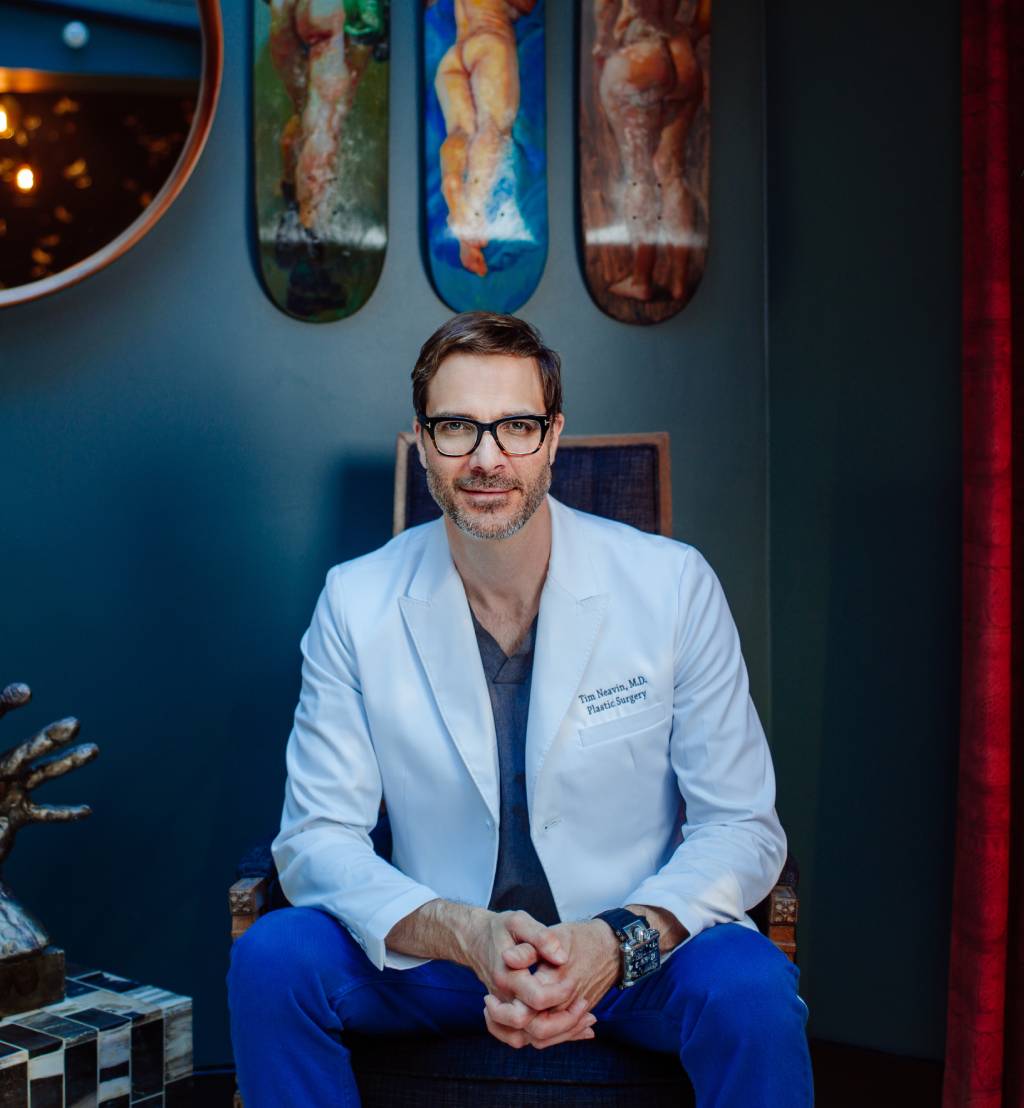
Dr. Tim Neavin understands that facial beauty is about balance, proportion, and harmony. With over 20 years of experience in facial plastic surgery, he approaches every implant procedure as an exercise in architectural precision—not just augmentation, but thoughtful reshaping of the facial skeleton to enhance your natural features.
Trained under world-renowned Beverly Hills surgeons, Dr. Neavin has placed hundreds of facial implants and developed a deep understanding of how bone structure, soft tissue, and skin work together to create attractive faces. He knows that the same implant can masculinize or feminize depending on placement—and uses this knowledge to deliver results tailored to each patient’s unique goals.
Dr. Neavin takes the time to analyze your facial proportions, discuss aesthetic ideals, and recommend the implant type, size, and placement that will create the most natural, harmonious outcome. His patients trust him because he’s honest about what will work, what won’t, and what to realistically expect.
Beverly Hills & Santa Barbara
Start Your Transformation
Schedule your private consultation with Dr. Neavin today.